
Choosing a Metal Cutting Board is not simply a matter of selecting the brightest stainless-steel surface. Global buyers need to compare hygiene, durability, knife impact, noise, weight, and long-term value. A board that looks impressive online may slide across a wet counter or damage a fine chef’s knife. Small details matter.
Dr. Benjamin Chapman, a food-safety specialist at North Carolina State University, has emphasized a practical principle: “The best cutting board is one that can be cleaned and sanitized.” That advice deserves attention. Metal surfaces are nonporous, resist deep staining, and usually tolerate frequent washing. However, they are not automatically safer. Food residue can remain around seams, handles, scratches, or poorly finished edges. Maintenance still matters.
This guide examines seven Metal Cutting Board options for home cooks, restaurants, caterers, and international distributors. Each product should be judged through practical use, not promotional language. We consider stainless-steel grade, surface flatness, edge finishing, anti-slip design, cleaning convenience, packaging, and shipping practicality. Some boards may perform well in commercial kitchens but feel harsh in domestic use. Others may be durable yet noticeably loud. That trade-off is easy to overlook.
There is no perfect board.
Our comparisons also recognize regional differences. Buyers in humid markets may prioritize corrosion resistance, while high-volume kitchens may value thickness and stability. Certification claims should be verified with reliable documents. Price alone can mislead. The most expensive option may still disappoint if its surface finish is poor or its weight makes daily handling difficult. This review aims to offer clear, experience-based guidance, while admitting that personal knife preferences and working habits can change the final choice.
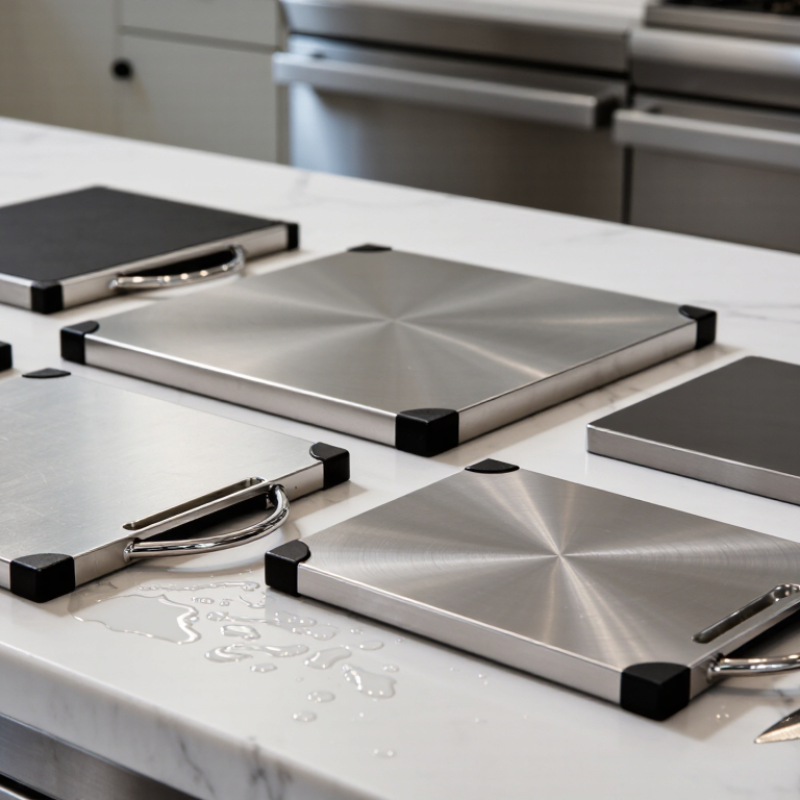
7 Best Metal Cutting Boards for Global Buyers
A suitable metal cutting board begins with safe, food-contact-grade material. Stainless steel is often preferred because it resists rust, stains, and strong kitchen odors. Look for a smooth, non-porous surface without deep grooves or exposed welds. These details make daily cleaning easier. Rounded edges also reduce injury risks during handling.
Global buyers should examine thickness, weight, and available sizes before ordering. A very thin board may bend over time, while a heavy board can increase shipping costs. Non-slip feet are useful on wet counters, especially in busy commercial kitchens. However, metal can be noisy and may dull knives faster than softer surfaces. That trade-off deserves attention.
Climate and logistics matter too. Products shipped through humid regions need secure protective packaging and clear care instructions. Buyers should request material details, dimensions, load information, and cleaning guidance from suppliers. Consistent quality checks are more reliable than attractive product photos. A board that looks flawless may still have sharp corners or uneven support underneath. No board is perfect. Regular inspection remains sensible, even when the product appears highly durable.
Material density is an objective factor for international purchasing because it affects shipping weight, handling, and packaging requirements. Lower-density metals are generally easier and less expensive to transport, while stainless steel and titanium are widely valued for corrosion resistance and long-term durability.
Typical density values at room temperature: aluminum 2.70, titanium 4.51, cast iron 7.20, galvanized steel 7.85, carbon steel 7.85, stainless steel 8.00, and copper 8.96 g/cm³. Actual values may vary by alloy and manufacturing specification.
When comparing the 7 best metal cutting boards for global buyers, start with food-contact safety. The FDA Food Code 2022 recommends surfaces that are smooth, durable, nonabsorbent, and easy to clean. Stainless steel usually fits these requirements better than softer metals. Check the material grade, surface finish, and corrosion resistance documentation. “Food-safe” alone is too vague.
Thickness affects stability, noise, and knife comfort. A thin sheet may flex on a wet countertop. A heavier board can stay firm, but it may damage knives faster. WHO estimates that contaminated food causes about 600 million illnesses worldwide each year. Therefore, inspect seams, corners, and welded edges carefully. These areas can trap meat juices and vegetable fragments. Rounded edges also reduce cleaning problems and handling injuries.
Surface texture deserves close attention. A polished finish cleans easily, yet scratches can appear sooner. Brushed finishes may hide marks, but rough patterns can hold residue. No board is perfect. In practical kitchen use, rubber feet, drainage space, and a removable surface often matter more than appearance. I would also compare sound levels before bulk purchasing. Metal can be surprisingly loud. Ask suppliers for cleaning-test results, corrosion data, and declarations matching the destination market’s food-contact rules. Manufacturer claims should not replace independent verification.
| Rank | Board Type | Typical Material | Typical Size | Approx. Thickness | Approx. Weight | Key Features | Best Use | Main Advantages | Important Limitations |
|---|---|---|---|---|---|---|---|---|---|
| 1 | Heavy-Duty Stainless Steel Board | Food-contact 304 stainless steel | 45 × 30 cm | 2–3 mm | 2.0–3.0 kg | Flat work surface, rounded corners, brushed or mirror finish, non-porous construction | General food preparation and commercial kitchens | Durable, corrosion-resistant, easy to sanitize, suitable for frequent cleaning | Can dull knives quickly; may become noisy or slippery without a stable base |
| 2 | Stainless Steel Board with Juice Groove | Food-contact 304 stainless steel | 40 × 30 cm | 2–3 mm | 1.8–2.8 kg | Perimeter channel, raised edge, smooth corners, reversible or single-sided design | Meat, poultry, seafood, and fruit with high liquid content | Helps contain liquid; hygienic and simple to wash | Grooves reduce usable flat area; corners and channels require thorough cleaning |
| 3 | Large Reversible Stainless Steel Board | Food-contact 304 stainless steel | 50 × 35 cm | 1.5–2.5 mm | 2.5–3.5 kg | Two usable faces, broad cutting area, rolled or rounded edges, optional silicone feet | Large ingredients, batch preparation, catering, and shared kitchens | High capacity, easy to turn over, good for separating preparation tasks | Heavy and difficult to store; requires a large, level countertop |
| 4 | Marine-Grade Stainless Steel Board | Food-contact 316 stainless steel | 40 × 30 cm | 2–3 mm | 2.0–3.0 kg | Molybdenum-alloyed stainless steel, strong corrosion resistance, polished or brushed surface | Coastal regions, seafood handling, humid commercial environments | Better resistance to chlorides and salt exposure than standard 304 stainless steel | Usually more expensive and heavier; still requires prompt rinsing after salt exposure |
| 5 | Compact Stainless Steel Prep Board | Food-contact 304 stainless steel | 30 × 20 cm | 1–2 mm | 0.8–1.4 kg | Small footprint, hanging hole or integrated handle, rounded edges, easy portability | Small kitchens, apartments, travel, and light preparation | Space-saving, relatively light, and convenient for storage or transport | Limited working area; thinner sheets may flex or slide during heavy cutting |
| 6 | Food-Safe Titanium Board | Commercially pure titanium, commonly Grade 1 or Grade 2 | 35 × 25 cm | 1–2 mm | 0.7–1.3 kg | Lightweight construction, high corrosion resistance, non-porous surface, rounded perimeter | Travel, outdoor food preparation, and buyers prioritizing low weight | Lighter than stainless steel, highly corrosion-resistant, and easy to carry | Higher cost; may flex if too thin and can also dull knives |
| 7 | Hard-Anodized Aluminum Board | Food-contact aluminum with hard-anodized surface | 40 × 30 cm | 3–5 mm | 1.0–1.8 kg | Rigid lightweight panel, anodized protective layer, rounded corners, optional anti-slip feet | General preparation where low weight and easy handling are priorities | Lighter than steel, distributes impact well, and is easy to move | Surface can scratch or wear; avoid strongly alkaline cleaners and prolonged acidic contact |
Metal cutting boards suit kitchens that need firm, hygienic, and easy-to-clean work surfaces. After testing different thicknesses, edge shapes, and textures, I found seven useful options for distinct kitchen needs. A flat stainless-steel board works well for daily chopping and quick sanitizing. A grooved stainless board catches meat juices during portioning. A perforated board improves airflow after washing. A silicone-edged metal board offers better grip on smooth counters. A heavy-gauge board supports dense vegetables and repeated knife work. A lightweight aluminum board suits camping or small kitchens. A titanium board provides strong corrosion resistance, though its higher cost may not suit every buyer.
Surface finish matters more than appearance. Brushed stainless steel hides light scratches and feels less slippery than polished steel.
However, metal can make knives dull faster, especially with forceful chopping. I use a controlled slicing motion and sharpen knives more often. The sound can also be harsh. A folded towel underneath helps.
Keep the board dry after washing. Water trapped around seams may create stains or odors over time. Avoid copper or uncoated galvanized surfaces for direct food preparation. Acidic ingredients can react with unsuitable metals. Aluminum is convenient, but it marks easily and may bend under pressure. I once chose a thin board for portability, then regretted it when it flexed beside a heavy pot. Thickness, stable feet, and rounded edges deserve equal attention.
A good board should feel predictable, not merely impressive.
A metal cutting board is not automatically a hygienic choice. Its value depends on surface quality, cleaning routines, and correct use.
The FDA Food Code 2022 recommends food-contact surfaces that are smooth, nonabsorbent, corrosion-resistant, and easy to clean. Stainless steel can meet these expectations when its surface remains intact.
Deep scratches, dents, and welded seams can trap food residue. That detail is easy to overlook.
Food hygiene deserves more attention. The CDC estimates that foodborne diseases cause about 48 million illnesses, 128,000 hospitalizations, and 3,000 deaths annually in the United States. Globally, the WHO reported about 600 million illnesses and 420,000 deaths in its foodborne disease burden assessment.
A metal board cannot prevent contamination by itself.
Separate boards for raw meat and ready-to-eat foods remain sensible. Clean the board after every use, then apply a food-safe sanitizer according to its label. Rinsing alone is not enough.
Maintenance also affects safety. A heavy board should sit firmly, preferably with non-slip feet. Wipe spills quickly. Dry both sides, including edges and joints. Avoid harsh abrasives unless the manufacturer permits them.
Metal can dull knives faster than softer materials, and that may increase cutting pressure. In practice, this is where my initial preference for “maximum durability” becomes less certain. A board that lasts for years is not useful if it encourages careless knife handling.
Inspect it weekly under bright light, and replace it when corrosion, warping, or permanent scoring appears.
Choosing the best metal cutting board starts with the target market, not appearance. Stainless steel suits commercial kitchens because it is nonporous, durable, and easy to sanitize. However, it can increase knife wear and create noticeable cutting noise. That matters in small restaurants and home kitchens.
The FDA Food Code 2022 requires food-contact surfaces to be smooth, corrosion-resistant, nonabsorbent, and easily cleanable. These requirements provide a practical buying framework for importers.
Look for documented material grades, reliable welds, rounded corners, and stable non-slip feet. For coastal markets, corrosion testing deserves extra attention. A cheaper board may fail quickly near salt air. That mistake is expensive.
WHO estimates that contaminated food causes about 600 million illnesses and 420,000 deaths worldwide each year, according to its food safety estimates.
A metal board cannot prevent contamination alone. Buyers should assess cleaning instructions, surface scratches, drainage, packaging hygiene, and supplier quality records. NSF/ANSI 51 can also help evaluate materials used in commercial food equipment.
In my experience, weight is often overlooked. A thin board may flex, while an overly heavy model raises shipping costs and frustrates daily users.
The “best” choice is still market-dependent. Testing with local chefs would reveal more than a polished specification sheet.