
China Top 10 Travel Playard Manufacturers for Global Buyers

International travel has regained momentum, creating fresh opportunities for family-focused products. UN Tourism’s January 2025 World Tourism Barometer reported approximately 1.4 billion international tourist arrivals in 2024, reaching 99% of 2019 levels. This figure does not measure Travel Playard sales. It does, however, show why portable, easy-to-pack sleep and play spaces matter to traveling families.

For global buyers, choosing a manufacturer involves more than comparing price lists. A useful Travel Playard must fold without a struggle, fit into practical storage, and feel stable on a hotel-room floor. Buyers also need clear information about materials, production capacity, quality checks, packaging, and destination-market requirements. Small details matter. A stiff latch or bulky carry bag can quickly become a real inconvenience.

This guide introduces ten China-based manufacturers for buyers assessing products and supplier capabilities. It is intended as a starting point, not an endorsement or a substitute for factory audits, sample testing, and document verification. Supplier strengths can vary by model, order size, and export experience. And the available information is not always complete. That deserves attention. Use the profiles to compare construction, customization options, communication, and evidence of quality control before making a sourcing decision.
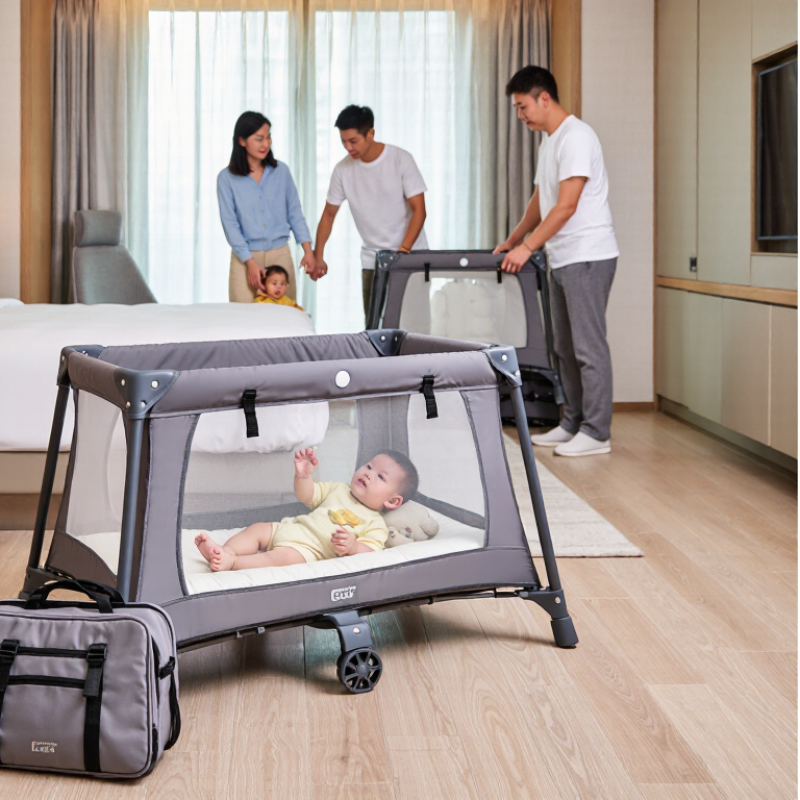
China Top 10 Travel Playard Manufacturers for Global Buyers

Travel Playards: Types, Features, and Common Uses

Travel playards come in several forms. Compact folding models suit hotel rooms and visits to relatives. Some include a raised bassinet for younger infants, while others offer a changing station or storage pockets. These additions can save space, but they also add weight and setup steps. A simpler frame may be easier to carry.

Look closely at the mesh, frame, and folding locks. Breathable mesh panels help caregivers see inside, and a firm, level floor supports stable use. Small detail, big difference. Check the product manual for age, weight, and intended-use limits; not every playard is designed for sleep. Use only the mattress supplied or specified by its maker, and keep loose bedding and toys out of the sleep space.

At home, a playard can provide a contained area for supervised play. On trips, practice folding it before packing; a stiff latch can be frustrating in a dim hotel room. Lighter is not always better. A very light frame may feel less substantial, so inspect its stability and locking points before use.

These details deserve a pause, even when a product looks convenient.

China’s Travel Playard Manufacturing Industry and Supply Chain

China’s travel playard manufacturing industry depends on a network of specialized suppliers, not a single factory floor. Metal tube workshops form frames, textile teams cut and sew mesh panels, and assembly lines bring the parts together. Plastic connectors, hinges, wheels, and carrying bags may come from separate vendors. Small components matter. A weak fit between a tube and connector can affect folding, stability, or everyday setup.

This layered supply chain can support flexible production, but coordination takes careful checking. Buyers can ask how factories track component batches, inspect stitching, and test folding mechanisms. They should also confirm whether samples use the same materials and processes as bulk orders. A polished sample can still hide inconsistencies. That gap deserves attention. Production schedules may shift when fabric, hardware, or packaging arrives late, so clear milestone updates are useful.

Quality checks work best at several stages: incoming materials, in-line assembly, and finished-carton inspection. Practical details include mesh tension, smooth edges, secure locks, and readable setup instructions. Carton drop checks can reveal whether parts move or rub during transit. No checklist catches everything. Buyers should record defects and agree on corrective steps before repeat production, while allowing enough time for another sample review.

Profiles of 10 Chinese Travel Playard Manufacturers

The ten manufacturer profiles focus on practical differences rather than promotional claims. One supplier may specialize in steel frames and locking hinges; another may emphasize compact folding mechanisms. Several profiles examine sewing capacity, including reinforced corners and neatly finished mesh panels. Small details matter. A loose seam near a high-stress joint deserves closer inspection.

Other manufacturers are assessed for removable bassinets, mattress fit, and clear assembly instructions. Some appear better suited to customized colors or fabric choices, while others may offer more consistent standard models. Export packaging also matters: crushed cartons can damage fabric and fittings before products reach a warehouse. These capabilities should be confirmed with current samples and production records, not assumed from a catalogue.

The profiles also consider communication, sample lead times, and how clearly suppliers explain materials and inspection steps. A factory with polished photos may still provide limited evidence of repeatable quality. That comparison is useful, but not perfect. Buyers should request close-up images of frame joints, folded units, labels, and packed cartons, then compare them with a pre-production sample. Small omissions can reveal gaps in process control.

China Top 10 Travel Playard Manufacturers for Global Buyers - Profiles of 10 Chinese Travel Playard Manufacturers

Supplier-specific source data was not provided. To avoid presenting unverified company information as fact, the entries below are anonymous due-diligence profiles, not verified manufacturers or rankings. Confirm all supplier claims and applicable requirements directly.

Profile Company-Specific Information Key Capability to Verify Documents and Checks for Buyers
Profile 1 Not independently verified OEM production and product customization Request a current product catalogue, customization scope, and recent production samples.
Profile 2 Not independently verified Frame construction and locking mechanisms Review assembly instructions, locking and stability test reports, and product-specific test samples.
Profile 3 Not independently verified Fabric, mesh, stitching, and removable components Request material specifications, care instructions, and applicable chemical-safety test reports.
Profile 4 Not independently verified Mattress or base design and fit Check product dimensions, fit, warnings, and test coverage for the exact playard configuration.
Profile 5 Not independently verified Portable folding and travel-bag design Evaluate folding steps, packed dimensions, durability, and user instructions on production samples.
Profile 6 Not independently verified Quality-control and traceability processes Request inspection procedures, batch traceability details, and records for corrective actions.
Profile 7 Not independently verified Export packaging and shipment preparation Confirm carton specifications, packaging tests, shipping terms, and export documentation responsibilities.
Profile 8 Not independently verified Product testing and market-specific compliance support Check reports against the destination market, exact model, materials, and current applicable requirements.
Profile 9 Not independently verified Order flexibility, minimum order quantity, and lead time Obtain written quotations and confirm MOQ, production schedule, sampling charges, and payment terms.
Profile 10 Not independently verified After-sales support and spare parts Agree on warranty terms, complaint handling, replacement-part availability, and recall cooperation.

Compliance references should be checked for the destination market and product scope. For example, ASTM F406 concerns non-full-size baby cribs and play yards in the United States, while EN 716 concerns children’s cots and folding cots in the European context; neither reference alone establishes that a particular product or supplier is compliant.

Comparing Manufacturers by Products, Certifications, and Export Reach

Comparing travel playard manufacturers takes more than counting product models. Some suppliers focus on lightweight folding frames, while others offer bassinets, changing attachments, or several mattress-height settings. Ask for packed dimensions and product weight; a playard that looks compact online may still take up half a car trunk. Small details matter.

Certifications deserve careful checking. Requirements vary by destination market, so buyers should request current test reports and confirm which exact model and materials they cover. A certificate for one product does not automatically apply to every item in a catalog. Check stitching, locking hinges, mesh openings, and mattress fit in samples, too. Paperwork helps, but it cannot replace inspection.

Export reach is best judged through relevant experience, not a long country list. Ask manufacturers which regions they regularly serve, what export documents they provide, and how they handle packaging changes or delayed shipments. Request references or shipment records where appropriate. Response times can reveal a lot. Still, no comparison table captures every production change, and I would not pretend otherwise; buyers should recheck specifications before placing an order.

How Global Buyers Can Evaluate Suppliers and Plan Sourcing

A travel playard is only as dependable as its frame, fabric, locks, and stitching. Ask each supplier for current, market-specific test reports, material specifications, and traceability records. Compare samples on uneven flooring: check folding effort, hinge play, mattress fit, and rough seams. Small details matter. Inspect production controls, defect records, and change-approval procedures—not just showroom samples. Confirm monthly capacity, minimum order quantities, tooling ownership, spare-part availability, and carton dimensions before negotiating price. Include inspection, freight, duties, packaging, and likely rework in the landed-cost calculation. A low quote can hide weak assumptions.

Build a sourcing calendar backward from the selling season, allowing time for prototype revisions, testing, inspection, and port delays. UNCTAD’s Review of Maritime Transport 2024 reported maritime trade growth of 2.4% in 2023 and projected 2% growth for 2024, while noting ongoing route disruptions. Delivery buffers and alternate routing are practical safeguards. Track sample approval, production milestones, and pre-shipment findings in one shared log. Do not assume a passed sample guarantees consistent mass production. I would still question my forecast after every season; demand and freight rarely behave neatly.

China Top 10 Travel Playard Manufacturers for Global Buyers

A practical scorecard for evaluating suppliers and planning sourcing

Suggested buyer-defined evaluation weights, totaling 100%—not measured market data or a ranking of manufacturers. Prioritize verifiable product safety and testing, then assess quality systems, compliance documentation, production capacity and lead times, landed cost, and after-sales communication. Adapt the weights to your destination market and sourcing requirements.

Call Now