Why Choose a Camping Gas Grill for Outdoor Cooking?
Why choose a Camping Gas Grill for outdoor cooking? The answer begins with control, portability, and reliable heat. Unlike charcoal, gas ignites quickly and produces fewer loose ashes around a campsite. That matters when breakfast must be served before sunrise.
The 2023 North American Camping Report from Kampgrounds of America recorded 57.8 million camping households in 2022. More campers are seeking practical cooking equipment, not elaborate outdoor kitchens. A compact Camping Gas Grill can cook sausages, vegetables, fish, and flatbreads on one small surface. It also supports faster cleanup after rain or limited-water trips. Barbecue educator Meathead Goldwyn, founder of AmazingRibs.com, offers a useful principle: “The best grill is the one you use most.” That idea applies strongly to camping equipment. A grill that fits the vehicle and starts easily may deliver more value than a larger model left at home.
However, convenience should not become careless confidence. The National Fire Protection Association reported an average of 11,980 home fires involving grills annually from 2017 to 2021. Although that figure covers home settings, it highlights a wider lesson: stable placement, ventilation, leak checks, and separation from tents remain essential. Follow the manufacturer’s instructions.
Small details matter. A wind shield can protect the flame. A built-in thermometer can prevent undercooked chicken. Still, no grill is perfect. Compact burners may heat unevenly, and fuel can run out unexpectedly. Buyers should compare cooking area, regulator quality, weight, cleaning access, and replacement-parts availability. The best choice is practical, safe, and suited to real outdoor habits.
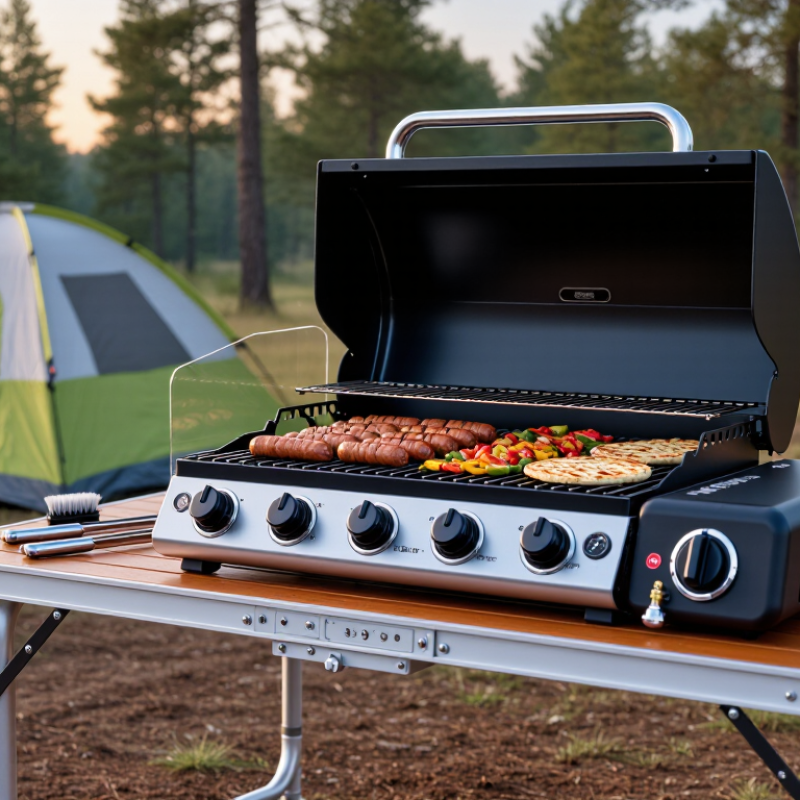
Fuel Choice: Propane Contains About 91,500 BTU per Gallon (EIA)
Why Choose a Camping Gas Grill for Outdoor Cooking?
Fuel efficiency matters when every item must fit inside a vehicle or backpack. The U.S. Energy Information Administration lists propane at about 91,500 BTU per gallon. That figure provides a useful energy baseline, not a promise of cooking speed. A grill transfers only part of that heat to the pan or grate. Wind, cold air, burner design, and lid insulation can change the result.
In practical camp cooking, propane offers quick heat with simple control. I can turn the flame down for eggs, then raise it for a cast-iron skillet. A steady blue flame also makes temperature changes easier to observe than glowing coals. A small cylinder may support several short meals, although actual fuel use depends on heat level and cooking time. Keep the cylinder upright, check the connection, and use the grill outdoors with clear airflow.
Small details matter.
I have found that people often trust the BTU number too much. A high rating may waste fuel if wind reaches the burner. A wind shield helps, but it can also trap heat around parts not designed for it. I would rather cook with moderate heat and a closed lid than chase maximum flame. Testing one meal at home can reveal how much propane your setup really consumes. That estimate will be imperfect, especially on a cold morning.
Portable Design: Compare Grill Weight, Cylinder Size, and Packed Volume
A camping gas grill earns its place when portability matters as much as cooking power. I have carried grills across gravel, wet grass, and narrow campsite paths. Weight becomes noticeable quickly. A grill under 10 kilograms feels manageable for short walks, while heavier models suit car-based camping better.
Cylinder size changes the whole setup. A small cylinder reduces carrying weight and packed volume, but it may empty during a long weekend. Larger cylinders last longer, yet they need more storage space and careful handling. Check the grill’s gas connection and the cylinder’s approved specifications before leaving home. Never judge portability by grill weight alone. Include the regulator, hose, cooking grate, tools, and fuel in your total calculation. My first choice was too compact, and the cooking surface felt cramped for four people.
Tips: Measure your vehicle’s storage space first. Pack the grill in its closed position. Compare packed dimensions, not only open dimensions. Leave room for the cylinder to remain upright and protected. A simple luggage scale can prevent unpleasant surprises. If you carry equipment far from the vehicle, choose the lighter grill. If you cook for several people, accept a little extra weight for a wider grate. I still prefer a slightly heavier model when windy conditions are likely, although that decision is not perfect. Wider legs and a stable frame can matter more than saving one kilogram.
Why Choose a Camping Gas Grill for Outdoor Cooking? - Portable Design: Compare Grill Weight, Cylinder Size, and Packed Volume
| Portable Grill Configuration | Approx. Weight | Typical Cylinder Size | Packed Dimensions | Packed Volume | Cooking Area | Best Use |
| Compact Tabletop Grill | 9.0 lb / 4.1 kg | 1 lb disposable cylinder | 17 × 12 × 8 in
43 × 30 × 20 cm | 1,632 in³
26.7 L | 180 in²
1,161 cm² | Solo trips and couples |
| Folding Tabletop Grill | 15.5 lb / 7.0 kg | 1 lb disposable cylinder | 22 × 14 × 10 in
56 × 36 × 25 cm | 3,080 in³
50.5 L | 240 in²
1,548 cm² | Picnics and small campsites |
| Two-Burner Portable Grill | 25.0 lb / 11.3 kg | 1 lb disposable or 5 lb refillable cylinder | 26 × 16 × 11 in
66 × 41 × 28 cm | 4,576 in³
75.0 L | 285 in²
1,839 cm² | Families and group meals |
| Compact Cart-Style Grill | 38.0 lb / 17.2 kg | 5 lb refillable cylinder | 32 × 19 × 14 in
81 × 48 × 36 cm | 8,512 in³
139.5 L | 360 in²
2,323 cm² | Car camping and tailgating |
Note: The figures above are representative specifications for common portable gas-grill configurations. Packed volume is calculated from the listed external dimensions and does not include the fuel cylinder unless stated. Actual weight, dimensions, and cylinder compatibility vary by design.
Cooking Performance: Match BTU Output and Cooking Area for Efficient Heat
A camping gas grill should be judged by useful heat, not impressive BTU numbers.
BTU measures fuel energy, while cooking performance depends on burner design, wind protection, and heat distribution. The U.S. Department of Energy states that 1 kilowatt equals approximately 3,412 BTU per hour. This helps compare specifications across different manuals and markets. However, higher output can waste fuel when the cooking area is small.
Match the burner output to the grate size. A compact grate with excessive heat may scorch burgers outside while leaving the center undercooked. The U.S. Department of Agriculture recommends 160°F for ground meats and 165°F for poultry. Use a reliable food thermometer, not color alone. For two campers, around 200 to 300 square inches can provide practical space for several portions. Larger groups need more room, but a wide grate also loses heat faster in wind. I have found that a lid and steady flame matter more than a dramatic rating. That assumption can still fail on cold mornings. NFPA data recorded an annual average of over 11,000 home fires involving grills, hibachis, or barbecues from 2017 to 2021, so stable placement and controlled heat deserve attention. A grill that heats evenly, recovers quickly after opening, and keeps temperatures predictable is usually the better outdoor cooking tool.
Safety Standards: Follow NFPA Guidance and Use DOT-Certified Cylinders
Why Choose a Camping Gas Grill for Outdoor Cooking?
A camping gas grill offers quick heat, controlled cooking, and less smoke around a campsite. Safety, however, begins before lighting the burner. Follow applicable NFPA guidance, local fire rules, and the grill’s operating instructions. Use the grill only outdoors, on stable ground, away from tents, vehicles, dry grass, and overhanging branches. Keep it simple.
Choose a DOT-certified cylinder with clear markings and an acceptable inspection or requalification date. The cylinder should match the grill’s approved fuel type and connection. Never force a fitting or use an adapter that the manufacturer does not specify. Inspect the hose, regulator, and valve for cracks, bending, corrosion, or loose connections. Small checks matter. Before each use, apply leak-detection solution to connections and open the valve slowly. Bubbles indicate a leak. Close the valve immediately, move away from ignition sources, and replace damaged parts through a qualified service provider.
During cooking, keep the lid and surrounding area clear of combustible items. Do not leave a lit grill unattended, even during a short meal. Turn off the burner, then close the cylinder valve after cooking. Allow the grill to cool before covering or transporting it. Store the cylinder upright, secured from falling, and away from heat or enclosed living spaces. I have found that rushed packing creates the greatest risk. A final visual check can feel excessive, but skipping it is the habit worth reconsidering.
Why Choose a Camping Gas Grill for Outdoor Cooking?
Safety Standards: Follow NFPA Guidance and Use DOT-Certified Cylinders
NFPA guidance limits a portable propane cylinder to a maximum liquid fill of 80%, leaving approximately 20% vapor space for thermal expansion. Always use a properly inspected and DOT-certified cylinder, keep it upright, and follow the grill and cylinder manufacturer’s instructions.
Environmental Factors: Estimate Propane Emissions with EPA Conversion Data
Why Choose a Camping Gas Grill for Outdoor Cooking?
A camping gas grill delivers steady heat beside a picnic table. It also allows cleaner fuel accounting than charcoal. The U.S. Environmental Protection Agency’s 2024 GHG Emission Factors Hub assigns liquefied petroleum gas 5.75 kilograms of CO2 per gallon burned. This is a useful baseline, not a complete climate assessment. It excludes cylinder production, fuel delivery, and equipment disposal.
The U.S. Energy Information Administration reports propane contains about 91,452 British thermal units per gallon. A 12,000-Btu-per-hour burner therefore consumes approximately 0.13 gallons hourly. Multiplying that amount by the EPA factor gives about 0.75 kilograms of CO2 per hour. Real cooking varies. Wind, cold air, preheating, and repeated lid opening can increase fuel use. Small details matter.
Consider a typical 20-pound propane cylinder. It holds roughly 4.7 gallons, producing about 27 kilograms of CO2 when fully burned. My first estimate ignored warm-up time, so it was too optimistic. Record the cylinder weight before and after a trip for better results. A simple kitchen scale can reveal your actual consumption. Gas cooking remains practical when fast heat, portion control, and measurable fuel use matter.