
What Are the Top Trampoline Manufacturers in China?
Choosing reliable Trampoline Manufacturers in China requires more than comparing product prices or factory photographs. A professional evaluation should examine manufacturing experience, safety testing, material quality, and communication practices. The strongest suppliers usually provide clear product specifications, stable production records, and traceable quality-control procedures.
Safety comes first.
A serious manufacturer should explain how it tests steel frames, springs, jumping mats, enclosures, padding, and stitching. Buyers should also request relevant certifications and independent test reports for their target markets. Standards may differ between countries, so one certificate cannot prove universal compliance. This detail is often overlooked.
Factory visits can reveal practical information that online catalogs hide. Inspectors may check welding points, powder-coating consistency, warehouse conditions, packaging strength, and final assembly. They can also compare stated capacity with actual equipment and staffing. However, a single visit is not enough evidence. Production quality may change across seasons, orders, or subcontracting arrangements.
This guide reviews leading Chinese Trampoline Manufacturers through a practical and cautious lens. It considers product range, customization ability, export experience, quality management, after-sales support, and transparent business communication. Customer feedback matters too, although reviews should be verified rather than accepted blindly. A polished website proves little.
The goal is not to identify one perfect supplier. Different buyers need different solutions, from compact backyard trampolines to commercial models for indoor amusement venues. Some manufacturers offer impressive customization but limited service coverage. Others provide stronger documentation but fewer design options. These trade-offs deserve attention before signing a contract, approving samples, or placing a large order.
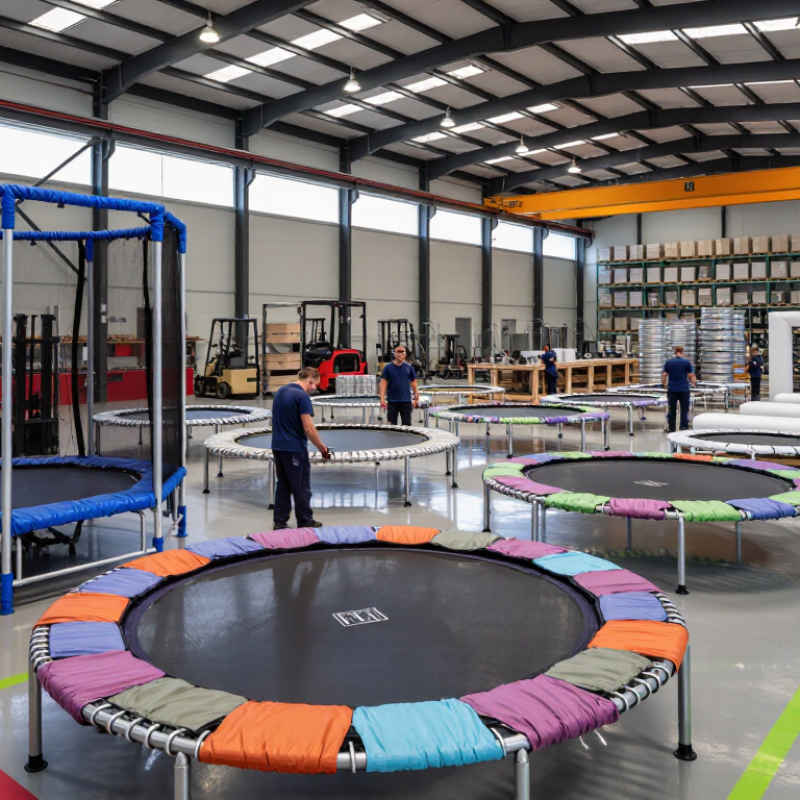
China’s Trampoline Manufacturing Industry Overview
China’s trampoline manufacturing industry sits within a much larger sports economy. The China Sporting Goods Federation reported that China’s sports industry reached approximately RMB 3.3 trillion in total output in 2022. Trampolines represent only a small segment, but demand is expanding through home fitness, family recreation, and indoor entertainment venues.
Top manufacturers usually operate in coastal industrial clusters, where steel processing, spring production, welding, fabric cutting, and packaging are nearby. This supply-chain density can shorten production cycles. It also supports customized frame sizes and private-label orders. However, supplier claims need careful checking. A factory certificate alone does not prove consistent quality.
Professional buyers should examine fatigue-test records, weld inspection procedures, mat tensile strength, and enclosure stability. ASTM F381 and European safety requirements are common reference points for product evaluation. The China Quality Certification Center also emphasizes traceability and process control in consumer-product manufacturing. These standards help, but testing methods may differ between facilities. That difference matters.
Market estimates from Grand View Research and IMARC indicate steady global trampoline-market growth, although their figures vary because commercial parks and household products are counted differently. China’s official statistics do not isolate trampoline manufacturing, creating an obvious data limitation. Factory visits remain useful. Look closely at spring storage, stitching lines, packing protection, and rejected components. The cheapest quotation is rarely the most reliable measure.
What Are the Top Trampoline Manufacturers in China? - China’s Trampoline Manufacturing Industry Overview
| Industry Dimension | China Industry Overview | Buyer Evaluation Focus |
|---|---|---|
| Manufacturing Geography | Production is commonly associated with developed sporting-goods and hardware supply chains in Zhejiang, Jiangsu, and Guangdong. | Check access to steel tubing, powder coating, plastic molding, mesh production, packaging, and export logistics. |
| Main Product Categories | The sector commonly supplies round backyard trampolines, compact indoor models, recreational center equipment, fitness trampolines, and replacement parts. | Confirm whether the factory specializes in residential, commercial, institutional, or fitness applications. |
| Typical Residential Sizes | Common retail configurations generally range from approximately 6 ft to 16 ft in diameter, with larger sizes requiring stronger frames and more extensive packaging. | Compare usable jumping area, frame height, enclosure height, carton dimensions, and installation requirements. |
| Frame Construction | Galvanized or powder-coated carbon-steel tubing is widely used for circular frames, legs, and enclosure poles. | Review steel grade, tube dimensions, weld quality, corrosion resistance, joint design, and load testing. |
| Jumping Mat Materials | Polypropylene woven mats with reinforced edge sections are commonly used because of their flexibility, strength, and outdoor performance. | Request information on weave density, UV resistance, stitching, attachment loops, and maximum user load. |
| Spring and Suspension Systems | Coated steel extension springs are widely used in residential trampolines, while compact fitness products may use elastic bands or alternative suspension systems. | Evaluate spring length, coating, fatigue resistance, spring count, attachment security, and replacement availability. |
| Safety Enclosures | Protective nets, padded poles, spring covers, ladder systems, and weather-resistant closures are standard components in outdoor models. | Check net strength, pole padding thickness, gap prevention, zipper or entry design, UV stability, and replacement parts. |
| Applicable Safety Standards | Relevant product requirements may include EN 71-14 for domestic trampolines and applicable ASTM trampoline safety specifications, depending on the destination market. | Ask for current laboratory reports tied to the exact model, materials, dimensions, and destination-market requirements. |
| Business Model | Many Chinese manufacturers support OEM and ODM production, including customized colors, packaging, manuals, labels, dimensions, and accessory combinations. | Assess engineering capability, sample approval procedures, artwork control, tooling ownership, and change-management processes. |
| Export Market Coverage | Chinese Trampoline Suppliers commonly serve North America, Europe, Australia, the Middle East, and Southeast Asia through distributors, retailers, and online channels. | Verify experience with local labeling, user instructions, packaging regulations, electrical requirements for accessories, and after-sales support. |
| Quality-Control Stages | A structured production process normally includes incoming-material inspection, welding checks, coating inspection, component assembly checks, finished-product testing, and pre-shipment inspection. | Request inspection records, loading photographs, test procedures, nonconformity reports, and corrective-action documentation. |
| Packaging and Shipping | Most residential trampolines are shipped in knock-down form using export cartons, molded or foam protection, printed manuals, and accessory bags. | Compare carton strength, dimensional weight, palletization, container utilization, drop-test performance, and assembly instructions. |
| Best Selection Criteria | The strongest suppliers combine documented safety testing, stable material sourcing, repeatable production, customization capability, spare-parts support, and export compliance. | Rank suppliers by verified compliance, product durability, communication, production capacity, total landed cost, and long-term service capability. |
Note: Product specifications, testing obligations, and available configurations vary by model and destination market. Buyers should verify current documentation for the exact product before placing an order.

