How to Choose Motorized Roller Shades in 2026?
Choosing motorized roller shades in 2026 is about more than tapping a button. The right system should fit the window, manage daylight, and work reliably in daily use. A shade that stops just above the sill can leave a bright strip of morning sun. A motor that cannot be serviced may become an expensive frustration.
The U.S. Department of Energy estimates that heat gain and heat loss through windows account for about 25–30% of residential heating and cooling energy use. That figure describes windows broadly, not savings guaranteed by any particular shade. Fabric openness, fit, orientation, and operating schedules all matter. Berkeley Lab researcher Dariush Arasteh has studied window performance; a practical paraphrase of that work is: “Treat the shade as part of the window system, not just a gadget.” This is a paraphrase, not a verbatim quotation.
This guide will compare motorized roller shades by fabric, motor type, power source, controls, installation, and maintenance. It will also explain what product claims can—and cannot—tell you about glare, privacy, and energy performance. Look closely at the fabric sample in daylight. A “light-filtering” label alone does not reveal how a room will feel at 3 p.m. on a west-facing window. Small details matter. So does restraint: automation cannot fix a poorly measured opening or a fabric chosen for the wrong room. Use the sections ahead to weigh comfort, compatibility, and long-term service before choosing a system.
Define Room Needs, Window Exposure, and Desired Light Control
A motorized roller shade should solve a room problem, not just look tidy in a window. Note how each space is used: a bedroom may need darkness at dawn, while a kitchen often benefits from soft daylight. Small details matter. Think about screen glare, afternoon heat, and whether someone needs to adjust the shade without reaching the window.
Track the sun for a day if you can. East-facing windows often receive bright morning light; west-facing rooms can grow uncomfortable in late afternoon. Nearby buildings and trees change that pattern, so compass direction alone is not enough. I would not assume one fabric suits every window. Compare samples in the room, at different times, and check how much light slips around the edges.
Decide what “light control” means to you: filtered daylight, reduced glare, or near-darkness for sleep. These are different goals. A lighter fabric can preserve a view but may still leave a room bright. A denser option blocks more light, though side gaps can remain. Measure the window carefully, including the frame, and confirm how the shade will mount. Also consider charging access and who will use the controls. It is easy to overlook the everyday routine.
Compare Solar-Fabric Openness Factors: 1%, 3%, and 5%
An openness factor describes how much of a solar screen’s fabric is open space. A 1% fabric has a tight weave, limiting direct glare and giving stronger daytime privacy. It suits bright, exposed windows, but the room may feel dimmer. The view gets softer. At 3%, small openings balance daylight, glare control, and outdoor visibility. This is often a practical middle ground for living rooms or home offices. A 5% fabric keeps a clearer view and admits more daylight, though low-angle sun can still create screen glare.
The percentage is only one part of the choice. Fabric color, window direction, and nearby buildings affect comfort too. Darker screens often preserve a sharper outward view, while lighter ones can soften incoming light. A south- or west-facing window may need more glare control than a shaded window, even if both use the same fabric. Motorized controls make it easier to lower shades as sunlight shifts, but they cannot fix a poor fabric match. A common mistake is choosing the most open weave just to keep the view. Test a sample against the actual window at midday and near sunset. The difference can surprise you.
How to Choose Motorized Roller Shades in 2026
Compare Solar-Fabric Openness Factors: 1%, 3%, and 5%
How to read this chart: Openness factor is the nominal percentage of a solar shade fabric made up of openings. A lower factor generally offers less outward visibility and more daytime glare control; a higher factor generally allows a clearer view and more daylight. Openness factor is not the same as the percentage of visible light transmitted. Actual performance also depends on fabric color, glazing, and lighting conditions.
Select Mount Type and Verify Window Clearances Before Measuring
How to Choose Motorized Roller Shades in 2026?
Choose the mount type before taking measurements. An inside mount sits within the window frame for a clean, built-in look, but it needs enough usable depth. An outside mount attaches above or beside the frame and can cover trim or reduce light gaps. Check whether the frame is square; older windows are not always perfectly even.
Verify clearances before measuring. Look for handles, locks, crank mechanisms, and projecting trim that could block the shade or its motor. For an inside mount, check the frame depth at several points and confirm that the headrail can fit without hitting the glass or hardware. For an outside mount, make sure there is a flat attachment area and room for the shade to hang freely. Small details matter. A handle that seems minor can stop a roller from moving smoothly. Follow the measuring instructions for your chosen mount, since required deductions can differ.
Tips: Open and close the window, then test each handle and lock. Check every window. Note any obstructions before measuring, and recheck your notes; it is easy to overlook a small difference between similar-looking windows.
Match Motor, Power Source, and Controls to Shade Size
How to Choose Motorized Roller Shades in 2026?
Match Motor, Power Source, and Controls to Shade Size
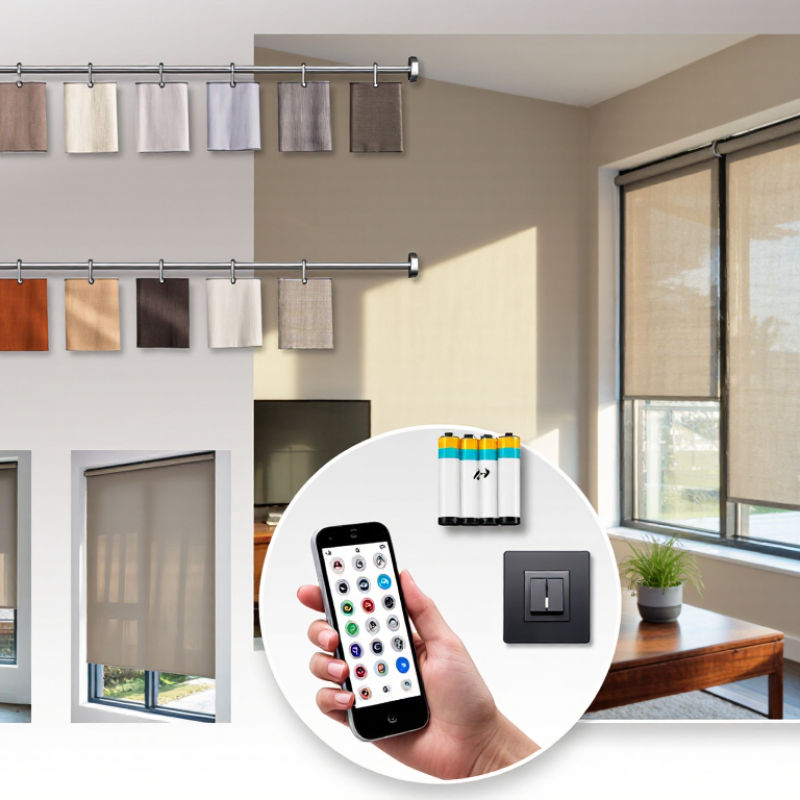
Start with the shade, not the remote. A wide window, heavy blackout fabric, or large roller tube places more load on the motor than a narrow, light-filtering shade. Ask the installer or supplier to match motor torque to the finished shade’s width, drop, fabric weight, and tube diameter. Measure each window carefully. Small errors matter.
Power should suit the room and the number of shades. Rechargeable battery motors avoid wall work, but frequent operation and large shades can mean more charging. Hardwired power suits multiple shades used daily, though wiring needs planning. Solar charging may help in bright locations, but deep eaves can limit exposure. A 2023 U.S. Department of Energy Energy Saver guide notes that about 76% of sunlight striking standard double-pane windows enters as heat during cooling seasons. That makes reliable scheduling useful in sunny rooms. Still, a shade motor cannot fix poor fabric selection.
Choose controls around real habits. A wall switch is simple; app or voice control can coordinate several rooms, but depends on network setup and compatibility. Confirm whether controls work locally if Wi-Fi fails, and check battery status before installation. Measure twice. Even careful estimates can miss a tight recess, an unusually heavy fabric, or a charging outlet that is just out of reach. Sources: U.S. Department of Energy, Energy Saver; motor sizing and installation guidance from professional window-treatment trade practice.
Check Cordless-Safety Compliance with ANSI/WCMA A100.1-2022
When comparing motorized roller shades, ask whether the exact model complies with ANSI/WCMA A100.1-2022. A motor alone does not prove cordless-safety compliance. The standard addresses safety requirements for window covering products, including cord-related hazards, testing, and product information. Request the manufacturer’s compliance documentation for the shade configuration you plan to buy, not just a general statement about a product line.
Inspect the sample closely.
Check for exposed lift cords, looped cords, or other reachable lines near the headrail and bottom bar. Look at the packaging and instructions for safety warnings and installation guidance. If the shade includes a charging cable, confirm that it can be removed or stored safely after charging.
Small details matter. I would still inspect the installed shade, even after reviewing its documents; a cord can hang differently once the brackets are mounted.
Ask how the product was tested and whether the documentation matches its fabric, size, and operating system. If those details are unclear, pause before ordering. A tidy display sample can be reassuring, but it cannot replace model-specific evidence.