
How to Source Automatic Blinds from Global Suppliers?
Sourcing automatic blinds from global suppliers looks simple until product samples, motor systems, and shipping schedules begin to conflict. A reliable process starts with a clear specification. Define window sizes, fabric openness, control methods, noise limits, battery life, and installation conditions. Small details matter. A living-room blind may need quiet movement, while a hotel project may require centralized control and stronger duty cycles.
Joel Spira, founder of Lutron and a pioneer in motorized shading, once said, “The purpose of technology is to enhance the quality of life.” That principle remains useful when comparing automatic blinds suppliers. Do not choose a factory only because its price is attractive. Review its motor supplier, testing procedures, software compatibility, and replacement-part policy. Ask for working samples, not only polished photographs. Test the blind repeatedly. Listen for uneven movement. Check whether the remote responds through a wall.
A serious supplier should provide clear specifications, production timelines, quality records, and export documentation. Factory audits can reveal storage problems, weak assembly controls, or inconsistent labeling. Independent testing may also help verify electrical safety and radio performance for the target market. Confirm applicable standards before placing a deposit.
The process is rarely tidy. A low minimum order may hide high customization costs. A fast sample may not represent mass production. Even experienced buyers miss details. Therefore, record every agreed feature in one technical file, including fabric codes, wiring diagrams, packaging dimensions, and warranty terms. The best global supplier is not always the cheapest. It is the partner that communicates clearly when something goes wrong.
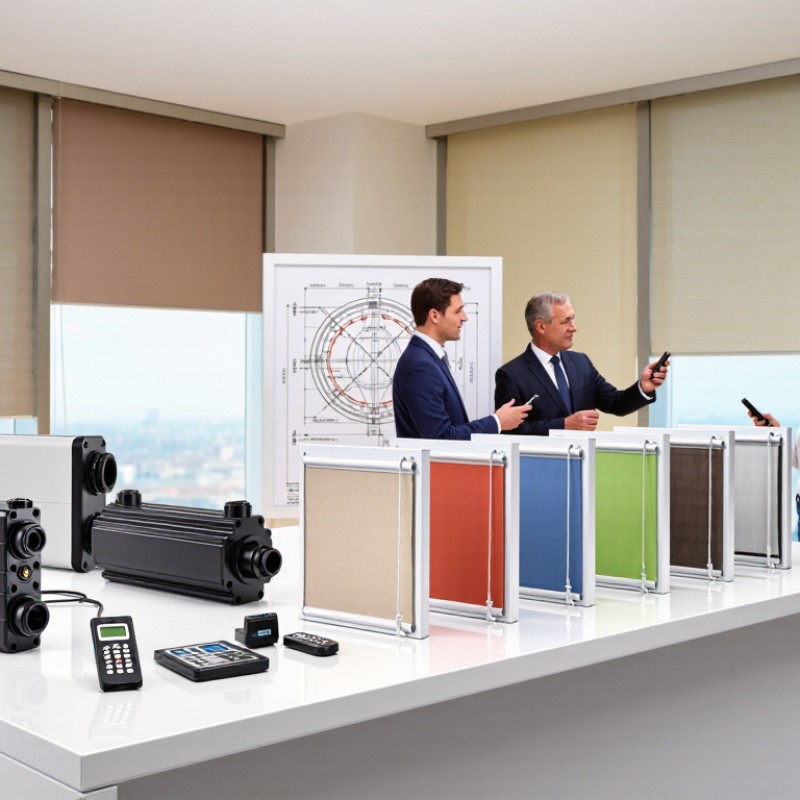
Understanding Automatic Blinds and Their Key Specifications
Understanding automatic blinds starts with their operating system, not their appearance. Most models use tubular motors, rechargeable batteries, or wired power. Check voltage compatibility before requesting samples. A motor should lift the blind smoothly without excessive noise. Ask suppliers for noise readings, lifting capacity, duty cycle, and expected battery life. These figures reveal more than polished product photos.
Fabric specifications also affect performance. Measure width, drop, tube diameter, and total blind weight carefully. Light-filtering fabric softens glare, while blackout fabric improves bedroom privacy. Openness factors, usually expressed as percentages, describe how much daylight passes through the material. Remote control, wall switch, timer, and app functions may be available. However, wireless systems can fail when signal coverage is weak. I have seen attractive samples perform poorly in rooms with thick walls. That detail is easy to miss.
Tips: Request one complete sample, not only a motor or fabric swatch. Test movement, noise, charging time, emergency operation, and installation hardware. Confirm whether the supplier provides wiring diagrams and replacement parts. Ask for test reports covering electrical safety and material quality. Specifications can still be incomplete. Compare the written data with real testing, and record every measurement before placing a larger order. A small trial order may cost more initially, but it can expose sizing errors, weak batteries, or inconsistent fabric tension before production expands.
How to Source Automatic Blinds from Global Suppliers? - Understanding Automatic Blinds and Their Key Specifications
| Specification | Typical Value or Range | Unit | Sourcing and Quality Considerations |
|---|---|---|---|
| Blind Types | Roller, Roman, Venetian, cellular, and dual-layer blinds | Type | Confirm whether the motor and mounting hardware are included with the selected blind system. |
| Maximum Blind Width | Approximately 2,000–4,000 | mm | The actual limit depends on fabric weight, tube diameter, motor torque, and installation method. Request a load chart. |
| Maximum Blind Height | Approximately 2,500–3,500 | mm | Verify fabric roll length, hem-bar clearance, and whether the quoted size refers to the blind or the complete assembly. |
| Motor Type | Tubular DC motor or tubular AC motor | Type | DC motors are commonly used for battery-powered systems; AC motors generally require fixed wiring and professional installation. |
| Rated Voltage | 12 or 24 | V DC | Match the motor, battery pack, charger, and control unit. Request electrical drawings before placing an order. |
| Torque Rating | Approximately 0.8–3.0 | N·m | Higher torque is needed for wider blinds, heavier fabrics, and larger roller tubes. Select by calculated load, not width alone. |
| Operating Speed | Approximately 10–40 | rpm | Higher speed reduces opening time but may increase operating noise and power consumption. |
| Operating Noise | Approximately 35–45 | dB(A) | Ask for test conditions, measuring distance, and load level because noise results vary by housing and installation surface. |
| Power Supply Options | Rechargeable battery, plug-in adapter, or hardwired supply | Configuration | Check charger input voltage, plug format, cable length, charging access, and local electrical requirements. |
| Battery Capacity | Approximately 1,500–2,600 | mAh | Battery life depends on blind size, fabric weight, operating cycles, temperature, and standby consumption. Request cycle-test results. |
| Control Methods | Remote control, wall switch, radio control, or app-enabled gateway | Method | Confirm communication frequency, control range, number of channels, pairing procedure, and offline operation. |
| Automation Functions | Open, close, stop, percentage positioning, schedules, and group control | Function | Request a demonstration of limit-setting, calibration, power recovery, and manual override functions. |
| Fabric Openness | Approximately 1%, 3%, or 5% | Openness factor | Lower openness generally provides greater glare and solar control. Require fabric samples and technical performance data. |
| Fabric Composition | Polyester, fiberglass-reinforced PVC, or polyester blends | Material | Check fabric weight, thickness, color consistency, edge quality, cleanability, and suitability for humid environments. |
| Ingress Protection | Often IP20 for indoor motor assemblies | IP rating | Do not assume outdoor suitability. For damp or exterior applications, request an appropriate tested IP rating. |
| Operating Temperature | Commonly 0–40 | °C | Confirm the rated temperature range for the complete system, especially for conservatories, unheated rooms, or exterior installations. |
| Installation Method | Inside mount, outside mount, ceiling mount, or wall mount | Method | Request dimensional drawings showing bracket spacing, cassette depth, minimum recess depth, and cable or charging access. |
| Measurement Tolerance | Typically ±1–2 | mm | Define whether the supplier deducts for brackets, fabric overlap, and light gaps. Approve a measurement form before production. |
| Safety Features | Obstacle detection, thermal protection, overload protection, and manual override | Feature | Verify which safety functions are standard, adjustable, or unavailable on the selected motor and control system. |
| Product Testing | Functional, endurance, electrical safety, and radio-performance testing | Test category | Request test reports, inspection records, sampling plans, and production photographs rather than relying only on catalogue specifications. |
| Packaging Requirements | Individual carton, moisture protection, corner protection, and installation labels | Requirement | Specify carton dimensions, barcode format, spare-parts policy, export packaging, and acceptable damage limits before shipment. |
Related Posts
-
How to Choose the Best Automatic Blinds?
-
10 Tips for Choosing the Best Automatic Blinds
-
10 Tips for Choosing the Best Automatic Blinds?
-
2026 Best Remote Control Blinds for Global Buyers
-
7 Tips for Buying Motorized Blinds Globally?
-
Top 5 Roller Blinds Trends Transforming Your Home in 2023 with Industry Insights

